How do interest rates work, and who decides them?
An interest rate is the price of money over time. Central banks set one key rate, and almost every loan, savings account and bond price you see moves in its shadow.
Education only, not investment, tax or legal advice. Crypto-assets are high-risk — risk disclosure.
The short answer
An interest rate is what a borrower pays, or a saver earns, for the use of money, shown as a yearly percentage. Central banks set a short-term policy rate; banks and markets then price loans, savings and bonds around it, adding margins for time, risk and costs.
Key takeaways
- An interest rate is the yearly cost of borrowing money or the reward for lending it, expressed as a percentage.
- In the US, the Federal Reserve's FOMC sets a target range for the federal funds rate; in the euro area, the ECB steers through its deposit facility rate.
- The APR on a loan includes fees as well as interest, so it is the fairer number for comparing offers.
- What matters for savers is the real rate: the nominal rate minus inflation.
- When market rates rise, the prices of existing fixed-rate bonds fall.
What is an interest rate, in plain terms?
An interest rate is the price of using someone else's money for a period of time. If you borrow, you pay it. If you save or lend, you earn it. Rates are almost always quoted per year, as a percentage of the amount borrowed or saved, which is called the principal.
Worked example
One year of interest (illustrative)
You keep 1,000 in a savings account that pays 4.5% a year, with interest paid once at the end of the year. After twelve months you have earned 45 in interest, for a balance of 1,045. If the interest is added more often, you also earn interest on interest; our compound interest explainer shows how that adds up.
Rates are not the same for everyone. The rate you are offered depends on who is lending, how long you borrow for, what the loan is for and how likely the lender thinks you are to repay. The starting point for all of them, though, is set by the central bank.
Who sets interest rates?
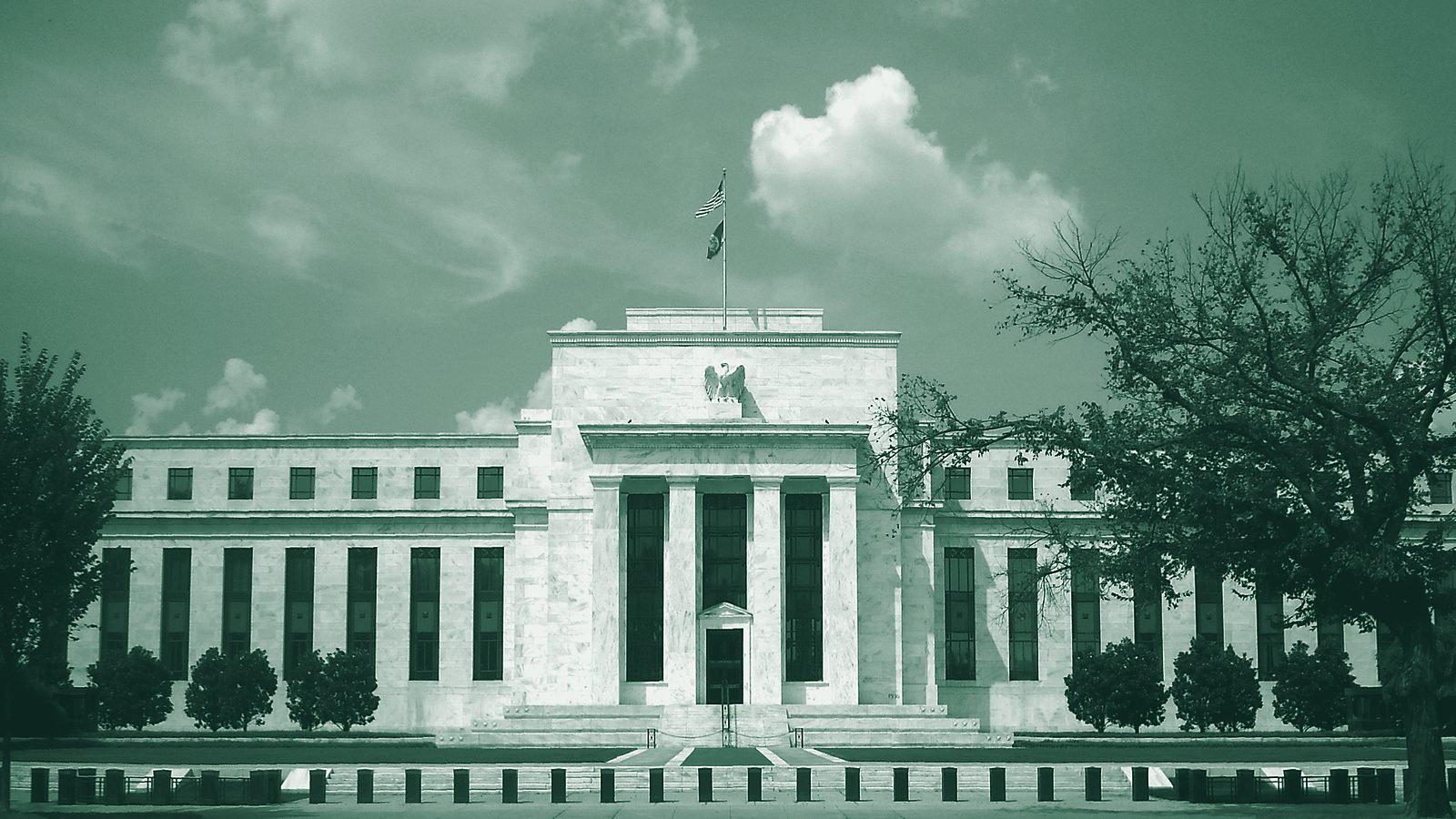
No single body sets every rate, but central banks set the one that anchors the rest. In the US, it is the federal funds rate: the rate banks charge each other to borrow overnight. The Federal Open Market Committee (FOMC) sets a target range for it1 and holds eight regularly scheduled meetings a year2. The committee has twelve members: the seven Fed governors, the president of the New York Fed and four of the other eleven regional Fed presidents, who rotate2.
The Fed keeps the market rate inside its target range mainly by changing the rate it pays banks on their reserve balances and the rate on its overnight reverse repurchase facility1. The European Central Bank works with three key rates: the deposit facility rate, the main refinancing operations rate and the marginal lending facility rate. In March 2024 it confirmed that it would keep steering its policy stance through the deposit facility rate6.
Figure · How a rate decision travels
- 01FOMC decisionsets a target range
- 02Fed funds rateovernight bank loans
- 03Other short ratesmove in response
- 04Spending choiceshouseholds and firms
Commercial banks then set their own rates for mortgages, car loans, credit cards and savings, and investors set bond yields by buying and selling. The policy rate is the starting point; each lender adds its own margin.
Why do central banks raise or cut rates?
In the US, Congress has given the Federal Reserve two goals, often called the dual mandate: maximum employment and stable prices. The Fed judges that inflation of 2% a year over the longer run, measured by the price index for personal consumption expenditures (PCE), is most consistent with stable prices3.
Its policy rate is how it pursues them. The Fed explains that changes in its target range influence short-term rates on other financial instruments, which in turn affect the spending decisions of households and businesses1. Higher borrowing costs make loans less attractive; lower costs make them more attractive. Central banks weigh those effects against their goals at each meeting.
Three central bank rates beginners hear about
What is the difference between an interest rate and an APR?
The headline interest rate on a loan is the yearly cost of the borrowed money alone. The annual percentage rate (APR) is broader: the Consumer Financial Protection Bureau explains that it also reflects points, broker fees and other charges you pay to get the loan5. Two loans with the same interest rate can have different APRs if one carries higher fees, so the APR is the better number for comparing offers.
What a two-point rate difference costs on a 20,000 loan over five years (illustrative, monthly payments, fees ignored)
| Annual rate | Monthly payment | Total interest |
|---|---|---|
| 5% | 377.42 | 2,645.48 |
| 7% | 396.02 | 3,761.44 |
You can test your own numbers with our loan payment calculator. On the savings side, accounts often quote an annual percentage yield (APY), which includes the effect of compounding; our APR to APY converter shows how the two relate.
What is a real interest rate?
The rate printed on an account is the nominal rate. What it buys you depends on inflation. The International Monetary Fund describes the real interest rate as the nominal rate minus the inflation rate7. Its example: a homeowner with a fixed 5% mortgage effectively pays a real rate of zero if inflation also runs at 5%, which helps the borrower at the lender's expense7.
Worked example
Is my savings rate beating inflation? (illustrative)
Your account pays 4% and prices rise 3% over the year. The quick rule gives a real return of about 1%. The exact figure is 1.04 ÷ 1.03 − 1, or roughly 0.97%. If inflation were 5% instead, the same account would lose purchasing power even though the balance went up. Our inflation explainer covers how prices are measured.
How do rate changes affect bonds and other investments?
Bonds show the effect of rate changes clearly. The SEC's investor bulletin on interest rate risk states the rule simply: market rates and bond prices generally move in opposite directions, so when rates rise, prices of fixed-rate bonds fall4. An old bond paying 3% is worth less once new bonds pay 4%.
The SEC's own example uses a Treasury bond with a 3% coupon. A year later, market rates have risen to 4% and the bond has nine years left; its price falls from $1,000 to $9254. The bulletin adds that bonds with longer maturities carry more interest rate risk4.
Figure · When rates move
Rates rise
- New loans cost more
- Savings accounts may pay more
- Existing fixed-rate bond prices fall
Rates fall
- New loans cost less
- Savings accounts may pay less
- Existing fixed-rate bond prices rise
Rates advertised on crypto platforms are a different thing. They are not set by a central bank and are not deposit rates at an insured bank. Our explainers on stablecoins and DeFi explain where such yields can come from.
What mistakes do people make with interest rates?
Common beginner mistakes
Comparing loans on the headline rate
Fees can make a lower-rate loan more expensive. Compare APRs, which include points and other charges5.
Forgetting inflation
A savings rate below inflation means your money buys less each year, even as the balance grows.
Treating bonds as immune to price swings
A fixed-rate bond's market price drops when rates rise4. If you sell before maturity, you get that market price, which may be below what you paid.
Thinking the central bank sets your mortgage rate
It sets a short-term policy rate. Your lender adds its own margin based on your credit, the loan term and its costs.
Risk warning
High rates usually mean high risk
If an offer pays far more than insured bank accounts or government bonds, ask where the return comes from and what happens to your money if the provider fails. Nothing here is investment advice; see our risk disclosure.
Frequently asked questions
How often does the Fed change interest rates?
The FOMC has eight scheduled meetings each year2 and can change its target range at any of them, or leave it unchanged.
What is a basis point?
A basis point is one hundredth of a percentage point. A move from 4.00% to 4.25% is a rise of 25 basis points.
What is the difference between a fixed and a variable rate?
A fixed rate stays the same for an agreed period, so your payments are predictable. A variable rate is linked to a benchmark and can move up or down, so payments can change.
Is APY the same as APR?
No. APR is mainly used for the cost of borrowing and, on loans, includes fees. APY is used for savings and shows what you earn in a year once interest on interest is counted, so it is higher than the simple rate whenever interest compounds more than once a year.
Do interest rates affect crypto prices?
Many investors watch central bank decisions closely, but no fixed rule links rates to any crypto price. Treat claims that a rate move will push a coin up or down as opinion, not fact.
Can interest rates go below zero?
The bottom line
Interest rates are the price of money over time. Central banks set a short-term policy rate in pursuit of goals such as stable prices, and lenders and markets build every other rate on top of it. When you borrow, compare APRs; when you save, compare the rate with inflation; and if you hold bonds, remember that rising rates push existing bond prices down.
Sources
- Economy at a Glance: Policy Rate — Board of Governors of the Federal Reserve System Primary source
- Federal Open Market Committee — Board of Governors of the Federal Reserve System Primary source
- What economic goals does the Federal Reserve seek to achieve through its monetary policy? — Board of Governors of the Federal Reserve System Primary source
- Investor Bulletin: Interest rate risk — When interest rates go up, prices of fixed-rate bonds fall (SEC Pub. No. 151) — U.S. Securities and Exchange Commission, Office of Investor Education and Advocacy, 2013 Primary source
- What is the difference between a mortgage interest rate and an APR? — Consumer Financial Protection Bureau Primary source
- Key ECB interest rates / Monetary policy decisions — European Central Bank Primary source
- Back to Basics: What Is Inflation? (Finance & Development, March 2010) — International Monetary Fund, 2010 Primary source
- How have central banks implemented negative policy rates? (BIS Quarterly Review, March 2016) — Bank for International Settlements, 2016 Primary source
How we checked this page: every figure above links to the numbered source it came from. Spotted an error? Tell the desk — see our editorial policy.
Read next
 Tools · CalculatorAPR to APY converter: how much does compounding really add?Two accounts can quote the same rate and still pay different amounts. Enter a rate and a compounding frequency to see the real yearly yield.
 Tools · CalculatorLoan payment calculator: what will a loan cost each month and in total?Enter the amount, the annual rate and the term to see the fixed monthly payment and how much of your money goes to interest rather than the loan itself.
 Finance · ExplainerWhat is compound interest, and why does time matter so much?Compound interest is interest that earns interest of its own. The idea fits in one sentence, but its effect over decades surprises almost everyone who runs the numbers for the first time.
 Finance · ExplainerWhat is inflation, and why does it shrink the value of your money?Inflation is the slow rise in the general price level that makes each dollar, euro or pound buy a little less every year. Understanding how it is measured makes headlines, savings rates and central bank decisions much easier to read.
 Finance · ExplainerHow do banks create money when they make a loan?Most of the money in your account was never printed. It was typed into existence by a bank when someone borrowed. Here is how that works, and what keeps it in check.
 Finance · ExplainerWhat is a money market fund, and is it as safe as a bank account?Money market funds are where many people and companies park cash they may need soon. They are built to be steady, but they are investments, not bank deposits, and that difference matters most in a crisis.