News analysis ·
Asset tokenization on Solana: how the SEC caps trading
Formation plans a Solana venue for tokenized shares under the SEC Innovation Exemption. We explain the volume caps, the AMM design and issuer vetoes.
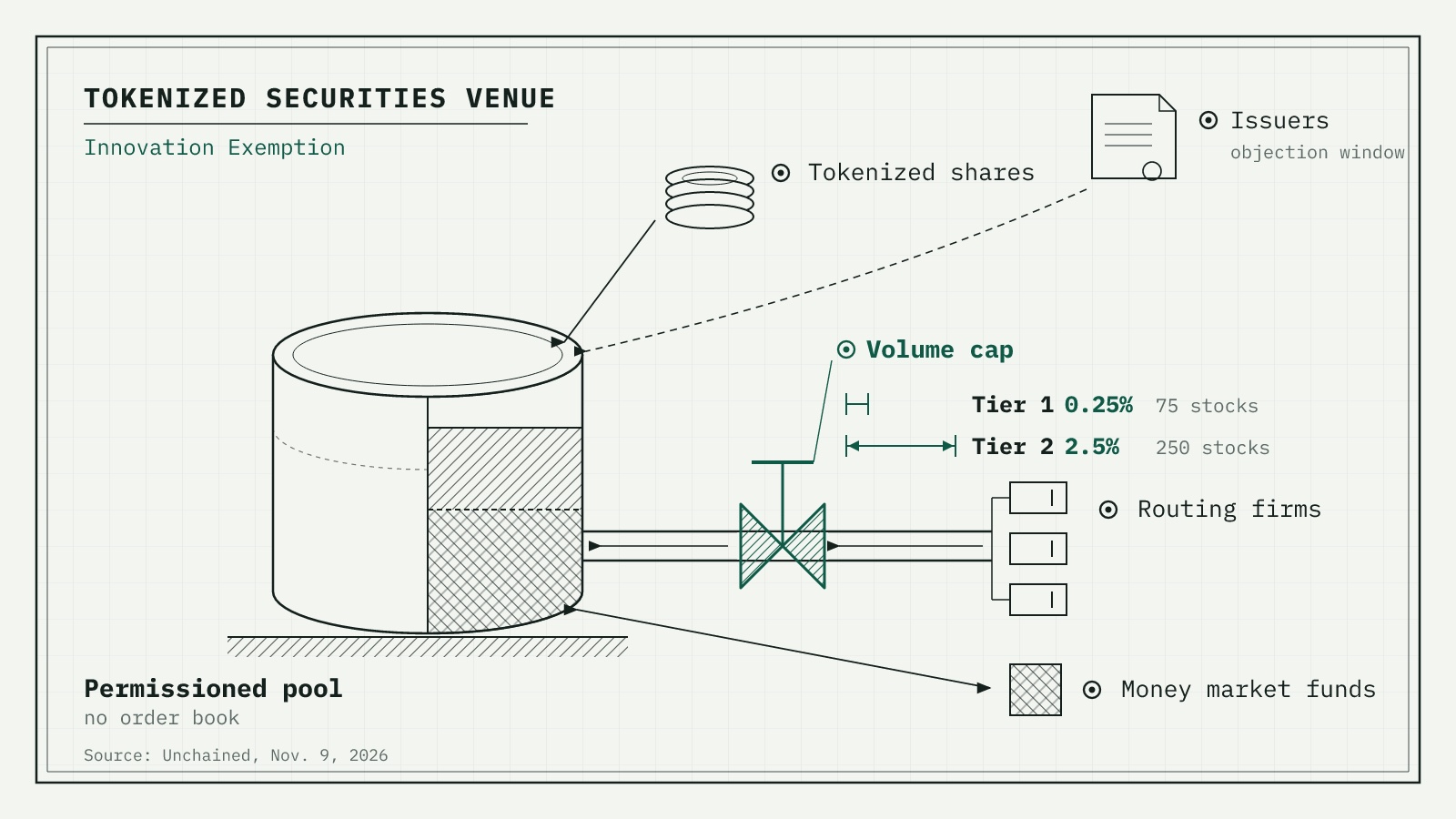
Formation Securities has posted a public notice saying it will run a trading venue for tokenized shares on the Solana blockchain, relying on an SEC exemption rather than SEC registration, Unchained reported. The plan leans on the SEC Innovation Exemption, which lets such venues operate inside tight limits. This article looks at how those limits work and what they say about where tokenized stocks fit in the market.
What happened
On Nov. 9, Formation posted a public notice saying it intends to operate a tokenized securities venue, or TSV, on Solana. Tokenized shares of three companies, Exodus Movement, Forward Industries and Galaxy Digital, are slated to trade there, and Formation expects trading to begin in early 2027. Its software is licensed from Orca, an automated market maker on Solana, and Formation calls the venue the first TSV on that chain.
The notice is not an approval. According to Unchained, it states that the SEC has not reviewed the merits or accuracy of what it discloses. The tokens themselves should come from Securitize and Superstate, while firms such as Anchorage Digital Bank, Alpaca, Fireblocks and BitGo are lined up to send investors to the venue. Formation is a wholly owned subsidiary of Valcrest, Inc.
What is asset tokenization, and how does this venue do it?
Asset tokenization means representing an existing asset, here a listed share, as a token on a blockchain so it can be held in a wallet and moved by software. The share still exists in the traditional system; the token is a new wrapper for trading and settlement. Formation's design adds several controls on top of that wrapper:
- No order book. Trades run through permissioned liquidity pools on licensed Orca smart contracts, where a formula sets the price from the pool's balances instead of matching buyers and sellers.
- A closed door. Only wallets that pass KYC and KYB checks, plus sanctions and wallet screening, may trade or add liquidity.
- Limited pairs. A tokenized stock can be swapped only for tokenized money market funds or for crypto assets that are not securities.
- Operator control. Formation does not hold user assets or keys, but it can upgrade or pause the contracts, set fees and edit the allowlist. Upgrades need multi-signature sign-off by staff; pauses do not.
That last point matters for risk. A pause can be triggered quickly by the operator, which helps in an emergency but also means trading depends on one firm's judgment.
How the volume caps work
The exemption is not a free pass. The SEC order behind it is Release 34-106402. That order lets each venue carry at most 75 Tier 1 stocks, with venue trading in each limited to 0.25% of its average daily share volume over the previous month. For Tier 2, the ceiling is 250 stocks, each capped at 2.5% of that same measure.
Here is how to read those numbers. The cap is not a fixed number of shares. It floats with each stock's own trading in the previous month. A heavily traded stock gives the venue a larger allowance; a quiet one gives a smaller allowance. The cap is also far tighter for Tier 1, which, under the Limit Up-Limit Down volatility plan the order borrows from, covers S&P 500 and Russell 1000 stocks plus some exchange-traded products. Tier 2 covers other listed stocks.
The effect is that a tokenized venue can only handle a small slice of the volume in the biggest stocks, so most of their trading stays on the main markets. For smaller listed names, the slice the venue may handle is relatively larger.
What changes, and for whom
For issuers, the key change is a say over third-party tokens. When an outside party creates the token and the company played no part, Formation has to tell the issuer first, then let the objection period run out before any listing. As of Nov. 9, no issuer had objected. A rival venue from OKX and ICE had drawn 67 issuer objections by its Nov. 5 notice, Unchained reported.
Formation's president, Christopher Montagano, framed issuers as partners: "Tokenized stocks will succeed only if public companies see the value in them, and we intend to build this market together with issuers". For investors, access is expected to come through the firms lined up to route them, and only after identity checks. The risks are plain: a tokenized share is a crypto-asset wrapper, its price can drift from the underlying stock, trading can be paused by the operator, and anyone who trades or supplies liquidity can lose money.
Open questions
The reports leave several points open. It is not yet clear how prices on an AMM pool will stay close to prices on the main exchanges, given the volume caps. Nor is it clear how the venue would handle a trading pause while the underlying stock keeps trading elsewhere.
There is also the basic question of demand. Lumida Wealth founder Ram Ahluwalia, speaking on Unchained's Bits + Bips on Nov. 2, doubted that tokenized stocks add value unless they solve a real customer problem. The project grew out of Project Open, pitched to the SEC Crypto Task Force in April 2025, and the SEC released the exemption in September. Early 2027 trading will be the first real test.
Sources
- Unchained, 9 Nov 2026
How this post was made: an AI model drafted it from the sources listed above, and software checks ran before it went live without a human edit. Every figure has to match a listed source and no sentence is copied. It explains how the mechanism works; it is not investment advice.