News analysis ·
ECB Finds $4.5 Trillion in Off-Balance Sheet AI Debt
The ECB counted $4.5 trillion in AI commitments that never appear as liabilities. How off-balance sheet obligations work and why supervisors care.
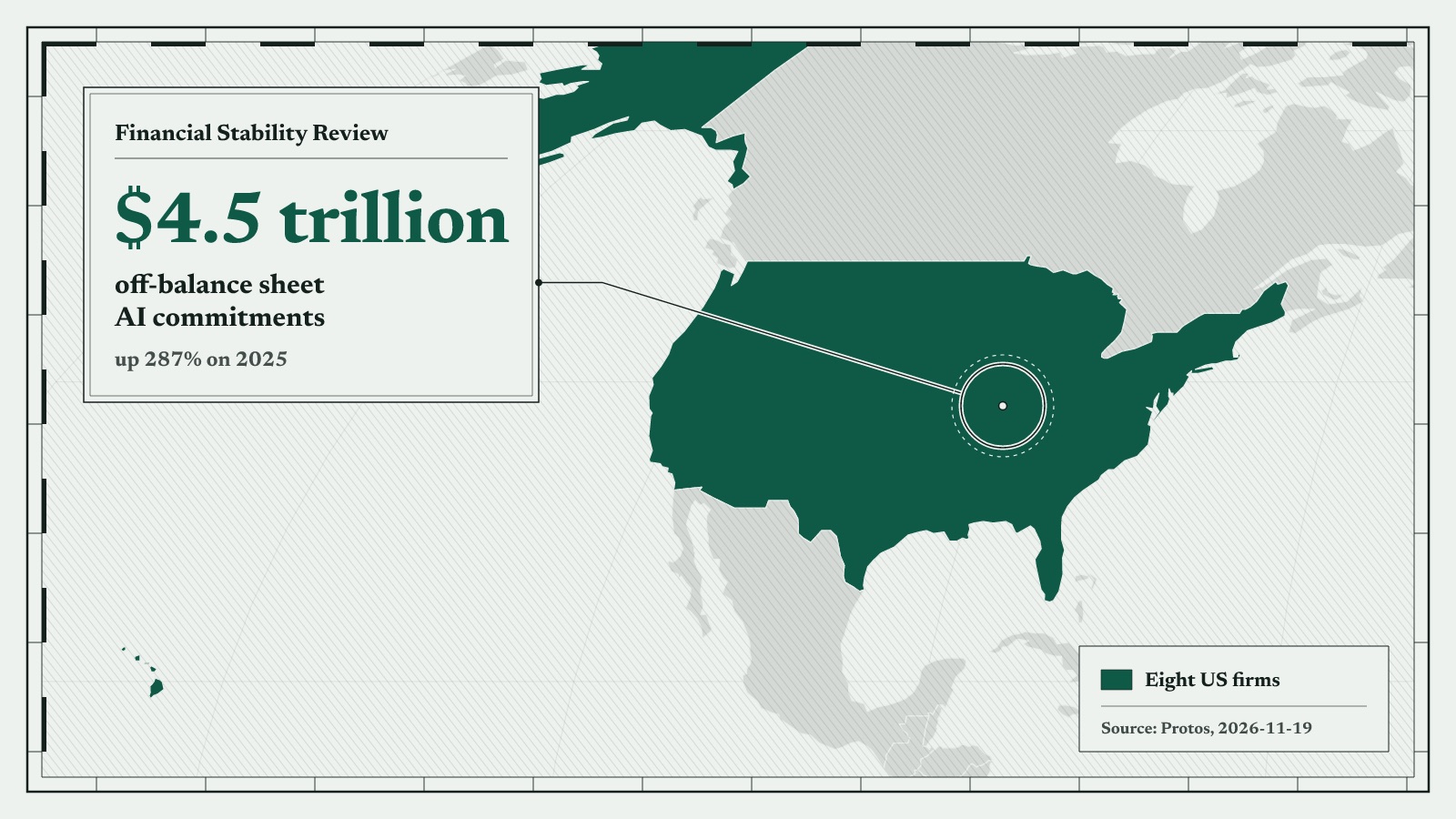
The European Central Bank has added up the promises the largest AI companies have made for data centers, cloud computing and chips, and arrived at $4.5 trillion, Protos reported. Almost none of it shows up as debt on their balance sheets. This article looks at how an obligation can be real enough to borrow against yet invisible in the main accounts, and why a central bank spends its time counting it.
What the ECB counted
In its Financial Stability Review, the ECB looked at eight firms: Microsoft, Alphabet, Amazon, Meta, Oracle, Nvidia, Broadcom and Anthropic. It summed their off-balance sheet commitments, meaning multi-year payments they have promised for renting data centers, buying computing power and acquiring chips. According to Protos, the total of $4.5 trillion is up 287% on the figure the ECB found in 2025, and it is far larger than the formal debt these companies report.
The ECB was not the first to look. Protos noted that the US Federal Reserve's own stability report, released the previous Friday, found above $1 trillion in signed leases that had not yet begun, plus over $2 trillion in take-or-pay deals and similar backstops at seven of the same firms. The Fed put the nominal total of such obligations at above $3 trillion. The ECB review appeared one day before Anthropic's $1 trillion IPO.
How this works: debt that is not called debt
A balance sheet lists what a company owns and what it owes at a point in time. Under US accounting standards, a lease is only recorded there once the asset behind it, such as a finished data center, is ready to use. Before that moment the company has signed a binding promise to pay, but the promise lives in the footnotes rather than in the liabilities column. Purchase commitments that have not started are treated the same way. The chain usually runs like this.
- Step one: a cloud provider signs a long-term contract to rent capacity or buy chips, often years before delivery.
- Step two: the payments are fixed in the contract, but no liability is booked until the asset is in service.
- Step three: on the other side, a provider holding a long client contract can pledge those future payments as collateral and borrow against them. Protos cited Oracle's $300 billion OpenAI deal as an example of such a contract.
- Step four: the result is a chain of obligations that behaves like borrowing but is spread across footnotes at several firms.
"Such cash flow commitments are debt-like in economic terms, but they do not appear as liabilities on the balance sheets of hyperscalers," the ECB wrote in its Financial Stability Review. A hyperscaler is a company that runs cloud computing at very large scale.
Why a central bank counts this: circular financing
A central bank's stability work is not about whether one company is a good business. It asks whether losses in one corner could travel through lenders and markets to the wider system. Hidden obligations matter because lenders, investors and supervisors may underestimate how much a firm already owes.
The second concern is circularity. ECB Vice-President Boris Vujcic described chipmakers and cloud providers investing in AI labs that then commit to buy their hardware and services. Fed Governor Michael Barr separately counted over $100 billion of stakes held by hyperscalers and GPU makers in AI labs and cloud startups, and used the same term. Protos noted the risk: when cash moves in a loop among related firms rather than coming from outside customers, reported revenue and forecasts can look stronger than real demand supports. The ECB compared the fast move toward debt finance with the dotcom and subprime bubbles.
What changes, and for whom
Nothing in the review changes accounting rules or forces any company to act. Its effect is on reading. For anyone looking at these firms, the headline debt figure is now only part of the picture; the footnotes on leases and purchase commitments carry obligations of a similar economic weight.
For lenders, the question is how much of their collateral is a promise from another firm in the same chain. For supervisors in Europe and the US, two separate counts now point the same way, which makes the topic harder to set aside in future reviews.
Open questions
The reports leave several things unclear. They do not say how much of the $4.5 trillion is due in any given year, which matters more for stress than the total. They do not show which lenders hold loans backed by client contracts, or how concentrated that exposure is. And the ECB and Fed counts use different firm lists and categories, so their figures describe overlapping but not identical pools of obligations.
Sources
- Protos, 19 Nov 2026
How this post was made: an AI model drafted it from the sources listed above, and software checks ran before it went live without a human edit. Every figure has to match a listed source and no sentence is copied. It explains how the mechanism works; it is not investment advice.