News analysis ·
How the Basel Committee Sets Bank Rules Without Law
The Basel Committee met on 18 November 2026 and queued two consultations. Here is how a body with no legal power still shapes bank rules.
Global bank supervisors gathered in Basel on 18 November 2026 as the Basel Committee on Banking Supervision and set two consultations on liquidity rules in motion, according to a statement published by the BIS. This article looks past the agenda to a simpler question: how does a committee whose decisions are not legally binding end up shaping the rules banks follow almost everywhere?
What happened in Basel
The BIS statement lists a long agenda. Members reviewed the Committee's work plan, strategic priorities and modernisation steps for 2027–28. Those plans now go to the Committee's oversight body, made up of central bank governors and supervisory chiefs, which is asked to endorse them in early 2027. The Committee also finished looking at targeted changes to its 2008 principles on managing and supervising liquidity risk. A consultation on revising them is due next month. A separate consultation, on technical fixes to the Liquidity Coverage Ratio and the counterparty credit risk standards, is due later this month.
On risks, members judged macroeconomic and geopolitical dangers still elevated. They pointed to energy and commodity costs, shifts in trade and the chance that interest rates stay higher for longer. They flagged interest rate risk in banks' own books, unrealised losses, refinancing in commercial real estate, and growing ties between banks and non-bank lenders, including private credit and financing for data centres and AI. Even so, the Committee said banks still hold broadly solid capital and liquidity, and that overall loan quality has not slipped materially. Work also continues on targeted parts of its standard for bank exposures to cryptoassets.
How a rule-maker without legal power works
The Committee is the world's main source of prudential standards for banks. Prudential means rules meant to keep a bank solvent and liquid, not rules about how it treats customers. Yet the BIS statement is blunt about its limits: the Committee has no supranational authority, and nothing it decides is legally binding. It relies on members keeping their commitments. The chain from a meeting in Basel to a rule a bank must obey runs roughly like this:
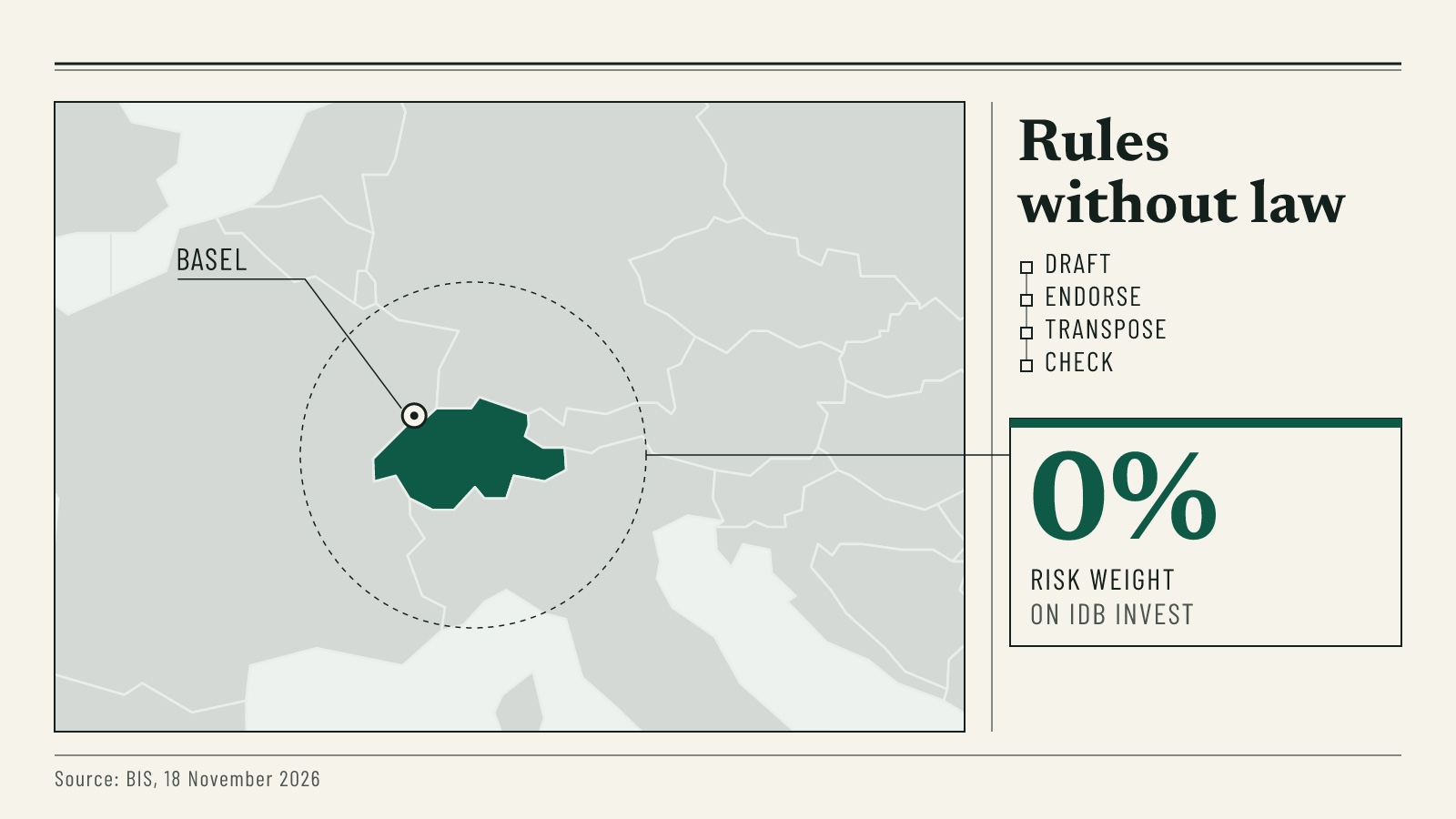
- Draft: the Committee writes a standard and consults the public on it, as it will do this month and next.
- Endorse: major decisions go to the oversight body of governors and supervisors, chaired by Bank of Canada Governor Tiff Macklem.
- Transpose: each member jurisdiction copies the standard into its own national law or supervisory rulebook. Only at this step does it become binding on banks.
- Check: the Regulatory Consistency Assessment Programme, or RCAP, uses peer reviews to test how closely each jurisdiction's rules match what was agreed.
The last step is the nearest thing the Committee has to enforcement. A published peer review shows whether a country's rules fall short. RCAP has already covered every part of the first Basel III package, the liquidity rules and the large exposures framework. Reviews of the remaining Basel III standards are now starting, beginning with revised credit risk and operational risk rules in Hong Kong SAR, due in the coming months. The Committee chair, Sveriges Riksbank Governor Erik Thedéen, framed the meeting's housekeeping this way: "The Committee also continued its discussions on ensuring that its governance and delivery mechanisms continue to be results-oriented, relevant and responsive".
Reading a 0% risk weight
One small decision shows how the machinery touches a bank's balance sheet. The BIS statement notes that supervisors may let banks give a 0% risk weight to claims on the Inter-American Investment Corporation, known as IDB Invest, using the criteria the Basel Framework sets out at CRE20.14.
A risk weight is a multiplier. A bank takes the amount it has lent or invested, multiplies it by the risk weight, and gets its risk-weighted assets. Minimum capital is then set as a share of those risk-weighted assets. The riskier the borrower, the higher the weight, and the more of its own money the bank must hold behind the loan. A 0% weight means that exposure adds nothing to risk-weighted assets, so it needs no capital under that calculation. Note the wording, too: supervisors may allow it. Because the Committee cannot bind anyone, even a relief is an option each national supervisor chooses to adopt or not.
What changes, and for whom
For banks, the near-term change is paperwork with teeth: the two consultations open a window to comment on liquidity rules before national supervisors adopt any final version. For supervisors, the agenda points at operational resilience. The BIS statement says cloud services, digital channels and AI improve efficiency but widen exposure to cyber attacks, fraud, outages and shared dependencies, so supervisors are stressing incident response and contingency planning. Members also reviewed how jurisdictions apply proportionality in Pillar 2, the part of the framework where supervisors judge each bank individually and can ask for extra capital.
Open questions
The statement does not say what the revised liquidity principles or the Liquidity Coverage Ratio fixes will contain; the consultation papers should answer that. It does not say which parts of the cryptoasset standard are under review, or when that review ends. And it gives no date for the 2027–28 priorities beyond the endorsement step in early 2027. Until each member writes the outcome into national rules, none of it binds a single bank.
Sources
- BIS, 18 Nov 2026
How this post was made: an AI model drafted it from the sources listed above, and software checks ran before it went live without a human edit. Every figure has to match a listed source and no sentence is copied. It explains how the mechanism works; it is not investment advice.