News analysis ·
Stablecoin vs tokenized deposit: SoFi links the two
SoFi launched SOFIE, a tokenized deposit that swaps one-for-one into its SoFiUSD stablecoin. We explain what legally separates the two tokens.
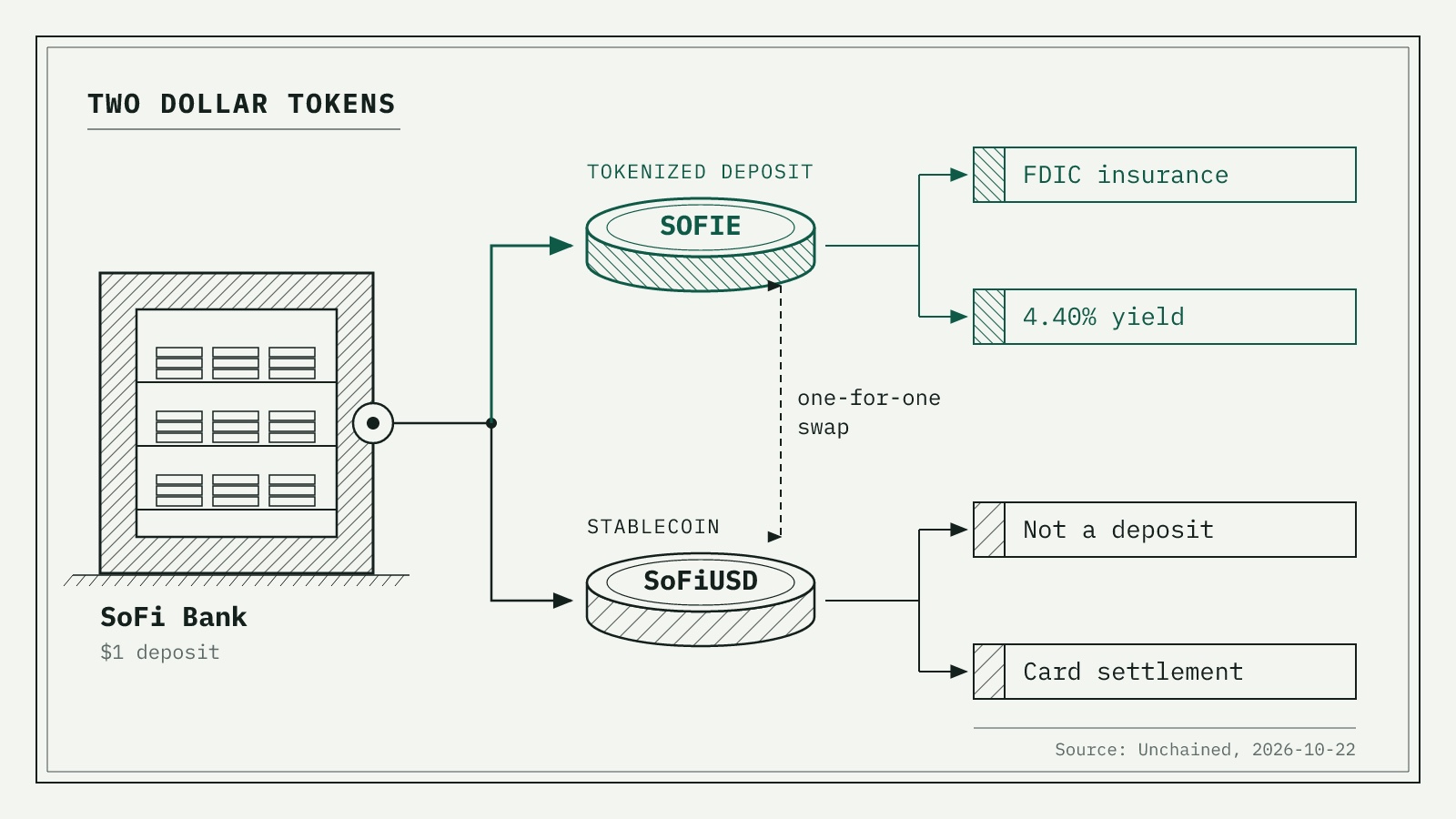
SoFi has launched SoFi Earn, or SOFIE, a token that represents an interest-paying deposit at SoFi Bank and can be swapped one-for-one into the bank's own stablecoin, SoFiUSD. Both tokens track the dollar and sit in the same app, yet they are different legal objects. This article looks at what separates them and why a bank would build a bridge between the two.
What SoFi launched
According to Unchained, SoFi Technologies rolled out SOFIE on Thursday for members of its crypto service. SoFi says every token represents $1 sitting at SoFi Bank and is covered by FDIC insurance up to applicable limits. The launch rate it listed was 4.40%, quoted as an annual percentage yield. The company calls it the first and only consumer tokenized deposit issued by a national bank. Members keep SOFIE inside their SoFi Crypto account. The rollout to that group runs from now through November, the company said.
The token does not travel on its own. Before spending, the holder converts it at a one-for-one rate into SoFiUSD, ticker SOFID. That stablecoin can be used for crypto purchases in the app or sent to supported outside wallets at any hour. SoFiUSD came first: it started in December 2025 for internal settlement and opened to members on May 27, 2026, when SoFi promised a conversion path into tokenized deposits. SoFi says its whole card program now settles in SoFiUSD over the Mastercard network, and Unchained reported that Payward, the parent of Kraken, agreed in September to list the coin and become part of the settlement network SoFi runs at all hours.
Stablecoin vs tokenized deposit: what is the difference?
A tokenized deposit is an ordinary bank deposit recorded as a token. The money is a claim on the bank, sits on its balance sheet and carries deposit insurance. A stablecoin is a separate claim on an issuer that promises to redeem at a dollar. SoFi's own disclosures draw this line: SoFiUSD is not a deposit and has no FDIC cover, while SOFIE counts as a deposit account held at SoFi Bank.
How the two-token design works
The simplest way to see the plumbing is to follow a dollar through the system. Each step changes what kind of claim the holder owns.
- Holding: dollars sit as SOFIE, a deposit at SoFi Bank. SoFi says it is covered by FDIC insurance up to applicable limits, and it listed a 4.40% launch yield.
- Switching: the holder swaps SOFIE one-for-one into SoFiUSD. SoFi's disclosures say SoFiUSD is not a deposit and has no FDIC cover, so the legal nature of the claim changes at this step.
- Spending: SoFiUSD can buy crypto in the app or go to supported outside wallets at any hour. SoFi also settles its card program in it over Mastercard, and Payward has agreed to list it.
- Returning: SoFi promised a conversion path into tokenized deposits when SoFiUSD opened to members. The reports do not describe how the reverse swap works in practice.
The split is a choice about where each job is done. One token is a bank deposit that carries the yield and the insurance. The other is a stablecoin built to move between wallets and firms. Keeping them apart means the interest-paying product and the freely moving coin are separate legal objects. The swap is the point where the protections change, which makes it the moment a holder should notice.
What changes, and for whom
SoFi's pitch is about idle money. CEO Anthony Noto said: "Too much money in the digital asset ecosystem is sitting idle, leaving massive potential earnings on the table for millions of people." To size that pool, SoFi cited Federal Reserve research estimating that roughly $64 billion, or 21.2% of all stablecoins, rests in dormant, forgotten or seldom-touched wallets. The Kansas City Fed reached the same share in an April estimate, which sorted stablecoin use into trading, transfer, payment and idle buckets.
For SoFi's 15.8 million members, the change is a choice of wrapper for the same dollar. A member who leaves funds as SOFIE gets the listed yield and the insurance SoFi describes; one who needs to move funds outside the bank switches to the stablecoin, which SoFi says has no FDIC cover. For the bank, SOFIE gives members a reason to hold dollars inside its own deposit account. Crypto bought with SoFiUSD can lose value, and the stablecoin side has no deposit insurance, so a member can lose money there. SOFIE is SoFi's fifth crypto product in under a year, after it began consumer crypto trading in November 2025 and grew to more than 40 coins.
Open questions
The reports leave several points unclear. They do not say how quickly a SOFIE-to-SoFiUSD swap settles, whether any fee applies, or whether the conversion can be paused. They do not say what backs SoFiUSD or how its reserves are held, which matters because the stablecoin side carries no deposit insurance. The 4.40% figure is a launch rate, and deposit rates can change.
Sources
- Unchained, 22 Oct 2026
How this post was made: an AI model drafted it from the sources listed above, and software checks ran before it went live without a human edit. Every figure has to match a listed source and no sentence is copied. It explains how the mechanism works; it is not investment advice.