News analysis ·
Systemic in Failure: How the FSB Judges Hidden Risk
FSB chair Andrew Bailey says size alone does not make a risk systemic. We explain the test regulators use: links, leverage, substitutability, speed.
Andrew Bailey, chair of the Financial Stability Board, told an IOSCO conference that regulators should stop treating size as the main sign of danger. According to the speech published by the Financial Stability Board on 2026-11-13, what matters more is what nobody can see: hidden leverage, tangled exposures and how fast confidence can vanish. This article explains how supervisors decide whether something is systemic, and why that test is shifting.
What Bailey said
Bailey built his keynote around one old crash. In October 1987, on Black Monday, the Dow lost 22.6% in a single session and the S&P 500 lost 20.47%. The US Brady Commission later found that selling in futures was dragging down stock prices, yet no one had real-time data linking the two markets.
He then moved to today. He pointed to the jump in long-dated US Treasury yields after US tariff announcements in April last year, which observers explained in conflicting ways. He cited the UK, where hedge fund deleveraging amplified gilt swings and their net gilt repo borrowing dropped around 40% from December 2025 to mid-April 2026. He also named private credit and stablecoins as two further cases, and said timely stablecoin data is sometimes absent. The Financial Stability Board notes the views are his own as chair, not necessarily the position of its members.
How this works: the systemic-in-failure test
A risk is systemic when trouble in one place can spread and damage the wider financial system. The old shortcut was size: big banks get the toughest rules. Bailey said global systemically important banks are already judged on more than size, including interconnectedness, complexity, cross-border reach and how hard their services are to replace.
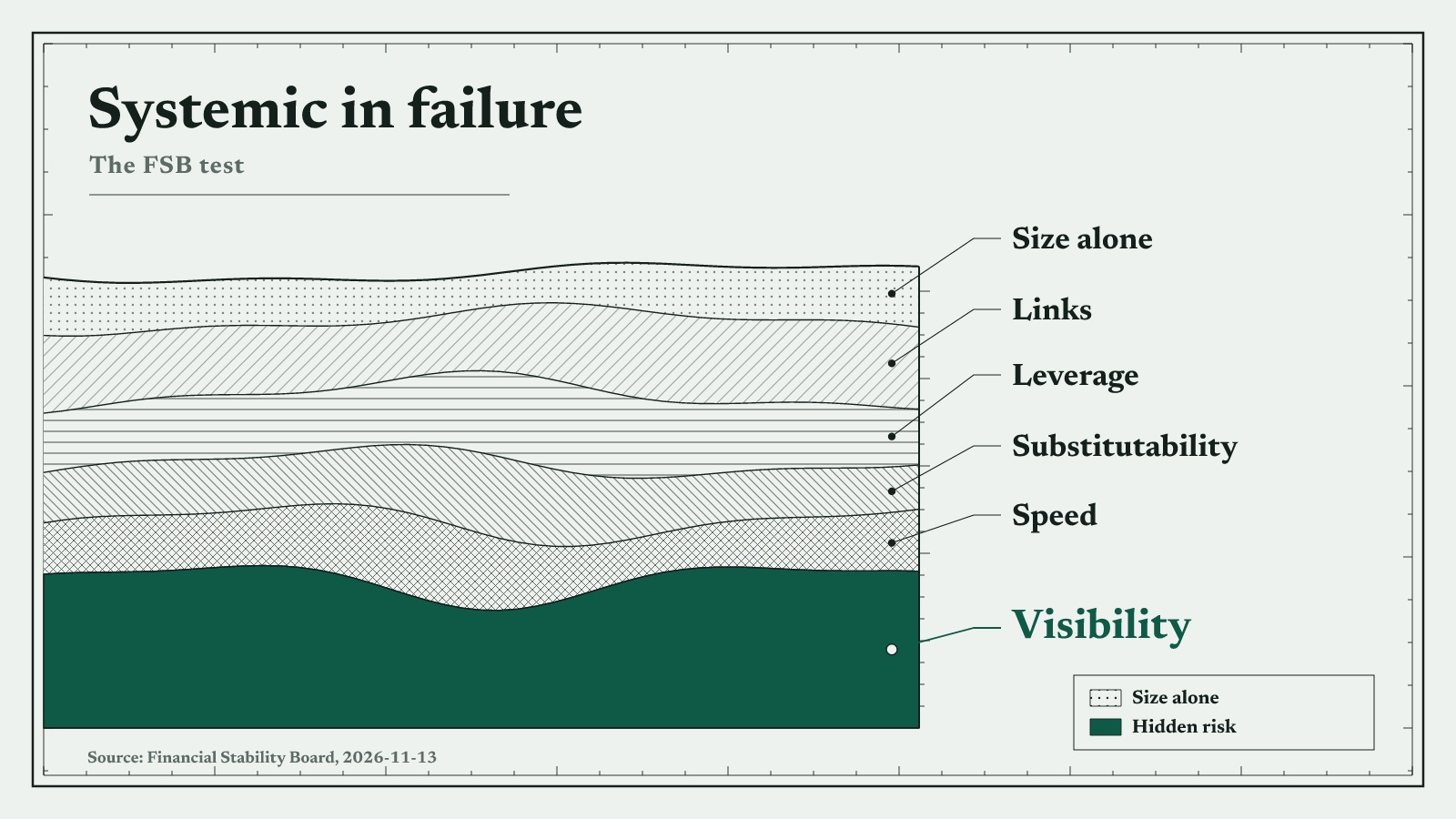
After Silicon Valley Bank failed, the Financial Stability Board increasingly asks whether an institution is systemic in failure. The question is not how large it looks on a normal day, but what its connections do on the day it breaks. Drawing on Bailey's examples, five questions follow from this test:
- Links: who is exposed to this firm or market, and through which contracts and collateral?
- Leverage: how much of the position is borrowed, and how fast must it be unwound if prices move?
- Substitutability: if it stops, can someone else quickly take over the function it performs?
- Speed: how quickly can users pull money out, and can the arrangement pay them without forced sales?
- Visibility: can authorities and investors actually see the exposures, or must they guess?
Here is a simple way to read the checklist. Picture two activities of the same size. One has borrowers and lenders spread across many firms, clear daily prices and a clearing house in the middle. The other is concentrated, rarely priced and tied to banks and insurers through private contracts. On paper they are equal. In a panic, the second is far more dangerous, because no one can tell who will take the loss. Bailey's point about Lehman Brothers in 2008 shows this: creditors eventually got back much more than crisis prices suggested, some recovering 100%, yet the fear was rational because the exposures were invisible at the time.
Why opacity turns a dip into a spiral
Bailey said fear in 2008 was justified because exposures were invisible. When people cannot see who holds the risk, assuming the worst is a reasonable reaction, and that is how trouble spreads. His gilt example shows a related effect: leveraged funds unwinding positions quickly amplified yield swings.
Central clearing is one existing tool against this. In his words it does not remove risk, but it makes exposures visible, standardises risk management and clarifies who owes whom. The Financial Stability Board has also created a Nonbank Data Task Force, whose first test case is leveraged trading in sovereign bond markets. Bailey urged authorities to apply the FSB 2025 leverage recommendations as well.
What changes, and for whom
For private credit funds, the message is that being smaller than the banking system is no defence. Rarely traded loans can hide stress for longer, and shared exposures could make the sector one domino in a chain. For stablecoin issuers, Bailey said the test is not market capitalisation but whether lost confidence triggers fast redemptions, and whether the arrangement can pay out without fire sales or disruption to payments and trading.
For regulators, the work is cooperation. Bailey called for common definitions, proportionate reporting and secure channels to share data across borders. One line from the speech captures the idea: "what we cannot see can matter just as much as what we can."
Open questions
The speech sets out a way of thinking, not new rules. It does not say what reporting private credit funds or stablecoin issuers would have to provide, which authority would collect it, or when. It also leaves open how much judgement supervisors will use before hard indicators flash red, and how firms would challenge a finding that they are systemic. Those details will decide whether the approach changes behaviour or stays a warning.
Sources
- Financial Stability Board, 13 Nov 2026
How this post was made: an AI model drafted it from the sources listed above, and software checks ran before it went live without a human edit. Every figure has to match a listed source and no sentence is copied. It explains how the mechanism works; it is not investment advice.