News analysis ·
Tokenization at DTCC: who keeps the record on Solana
DTCC plans to link its tokenization service to Solana in late 2027. We explain who keeps the official record, and the limits on wallets and assets.
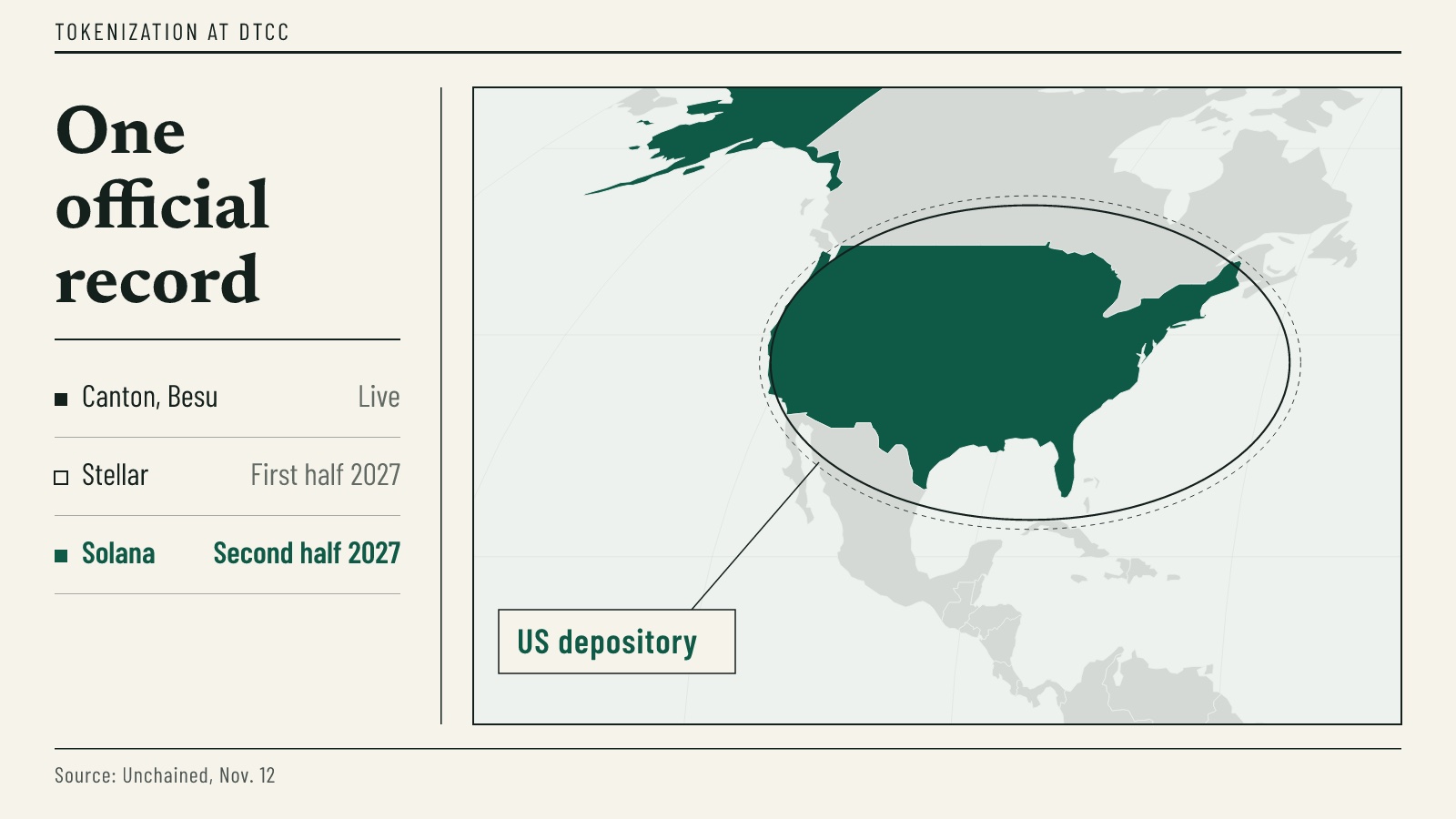
DTCC, the group at the centre of US securities clearing and custody, aims to hook its tokenization service up to the Solana blockchain in the second half of 2027, Unchained reported. The headline sounds like stocks moving onto a public chain. This article looks at what actually moves, who still holds the official record, and which limits come with it.
What happened
On Nov. 12, DTCC announced a plan to link the DTCC Tokenization Service, known as DTS, to Solana. According to Unchained, which counted the networks in DTCC's documents, Solana is the fifth chain named for the service. Canton and DTCC's private Besu network were live when DTS launched. Stellar is set for the first half of 2027, and Circle's Arc chain is expected in 2027. DTCC says the roadmap may change.
DTS has run since Oct. 28. It lets eligible clients of the Depository Trust Company, DTCC's custody arm, turn a holding into a token and turn it back again. Morgan Stanley said it was using DTS six days after launch. DTCC expects the Solana link to process conversions of eligible assets held at DTC, plus lifecycle jobs such as servicing each token, but it has not said which assets would go to Solana.
What is asset tokenization at a depository?
Asset tokenization means representing an existing asset, such as a share or a bond, as a token on a blockchain. At DTCC the token does not replace the underlying security. According to a one-page DTCC overview cited by Unchained, DTC remains the keeper of the official records whether a position sits in its books in the usual way or circulates as a token.
- A participant, meaning a firm with an account at DTC, asks to convert an eligible position into a token.
- The token is issued on one of the ledgers DTC has listed, into a wallet that the participant has registered.
- The token can move only between registered wallets, so every holder is a known DTC participant.
- DTC keeps the authoritative record throughout, and the token can be converted back into a traditional holding.
This is the key to reading the news. A depository is the central bookkeeper that records who owns which securities. Clearing and settlement, the steps that confirm a trade and swap the security for cash, depend on that book being right. Per the overview, DTC keeps that book as the official record, and each chain is another place where a position can be held and moved under DTC's rules.
The rules that box it in
DTS operates under a no-action letter from SEC staff to DTC, dated Dec. 11, 2025. A no-action letter is a statement from regulators' staff that they would not recommend enforcement if a service runs as described. It is not a new law, and it can be narrow. This one names no blockchain. The staff relief also has a clock: it runs out three years after the covered pilot version goes live at DTC.
Only certain securities qualify: Russell 1000 stocks, US Treasury bills, notes and bonds, and ETFs that follow major indices.
One detail matters more than it first appears. In its own risk checks, DTC gives the tokens no collateral value and no settlement value. DTC normally counts what a participant holds when it decides how much risk that firm can take on. A token that counts for nothing in that calculation does not add to the risk capacity DTC gives a participant. In DTC's own checks, then, the token carries less weight than the traditional holding it came from.
What changes, and for whom
For participant firms, Solana would be one more ledger to choose from. Nick Ducoff of the Solana Foundation said institutions pick Solana because it already carries real financial activity at scale. Formation Securities plans a Solana venue for tokenized shares in 2027, so tokens issued through DTS on Solana could sit on the same network as such trading.
Brian Steele, president of DTCC Clearing and Securities Services, said tokens on Solana would "retain the same investor protections, ownership rights and regulatory safeguards that apply to traditionally held securities." For individual investors, nothing changes directly. Access runs through participant firms, and wallets outside the registered set cannot hold the tokens.
Open questions
The reports leave several gaps. DTCC has not named the assets planned for Solana. It is not clear what happens if a token and DTC's book ever disagree, beyond the fact that DTC's record is the official one. The no-action relief expires after three years, and the reports do not say what framework would follow. And because the tokens carry no collateral or settlement value at DTC, it remains open whether that limit is a pilot setting or a lasting design choice. Those are the main tokenization risks to watch.
Sources
- Unchained, 12 Nov 2026
How this post was made: an AI model drafted it from the sources listed above, and software checks ran before it went live without a human edit. Every figure has to match a listed source and no sentence is copied. It explains how the mechanism works; it is not investment advice.