News analysis ·
Central banks join BLOOM: how token settlement works
Malaysia and Thailand joined Singapore's BLOOM. We explain how it aims to settle cross-border deals in stablecoins and tokenized deposits.
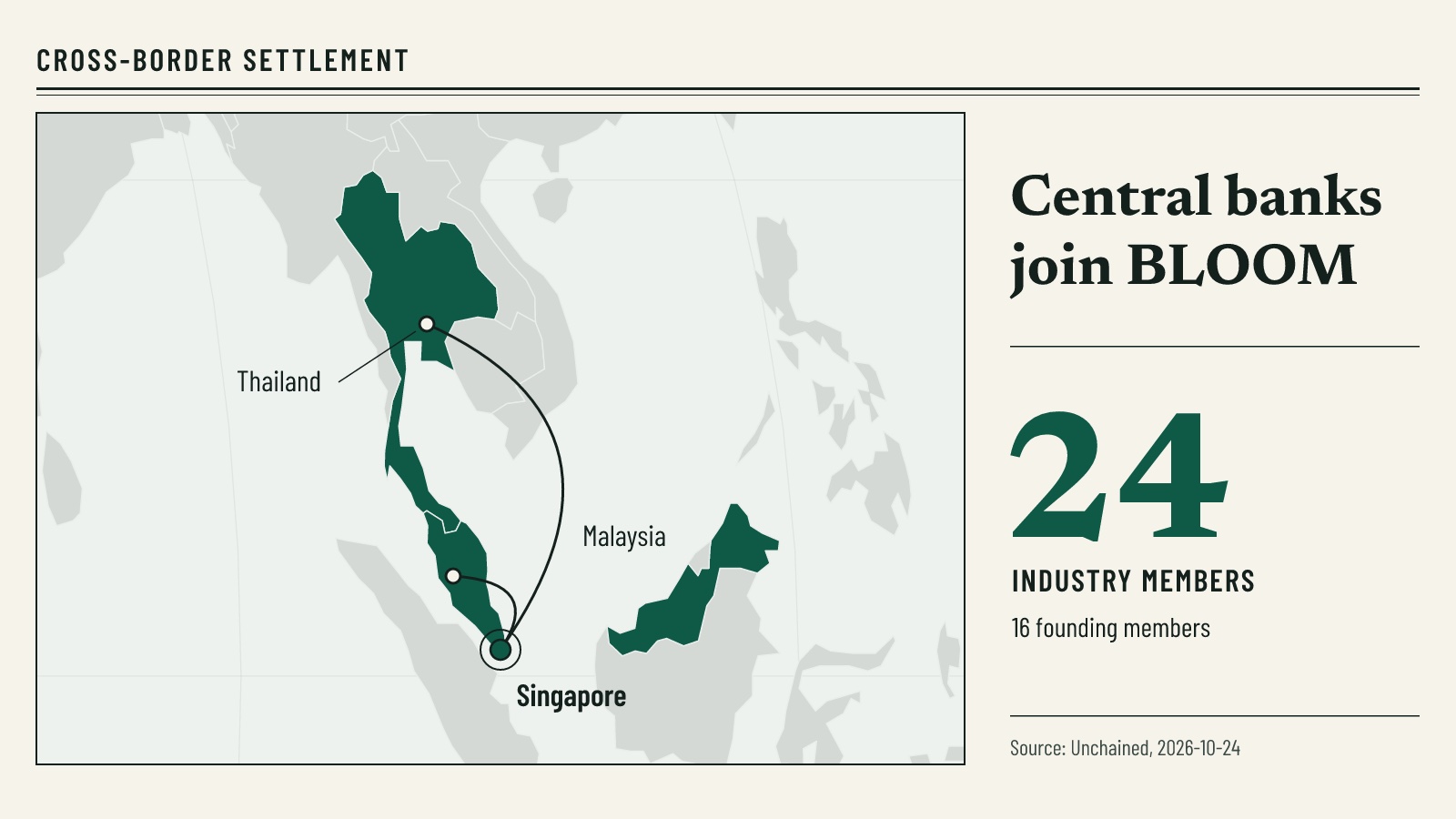
Singapore's central bank has added the central banks of Malaysia and Thailand to BLOOM, its program for settling cross-border payments in regulated digital money. Nothing under the program is live yet, and no token has been chosen. This article looks at the plumbing BLOOM is trying to build, and what a second and third central bank add to it.
What happened
On Oct. 23 the Monetary Authority of Singapore, or MAS, said the central banks of Malaysia and Thailand had become policymaker members of BLOOM, Unchained reported. Until now MAS ran the program alone. It now has three central bank members, next to a list of private firms that an MAS annex puts at 24 industry members.
The newly listed firms include card networks Visa and Mastercard, along with Ripple, Airwallex, Nium, ShopeePay, Monee and Maybank. The World Bank Group joined in a separate category for development lenders. MAS launched BLOOM in October 2025 with 16 founding members, among them DBS, J.P. Morgan, Kasikornbank, Circle, StraitsX, Coinbase, Stripe and Anchorage Digital. It follows Project Orchid, the digital Singapore dollar research that MAS began in 2021.
How this works: why cross-border settlement is hard
When a bank in one country pays a firm in another, the money does not fly across the border. Banks keep accounts with each other, often through a chain of correspondent banks, and each link needs its own contract, its own compliance checks and its own funded account. Settlement, the moment the payment becomes final, can take days and depends on banking hours in several time zones.
BLOOM tries to replace many of those private links with shared rules. MAS said the aim is to spare institutions from building a separate arrangement with every counterparty or market. In practice the work has a few parts:
- Acceptance: agreeing which forms of digital money a bank in one country will take from a bank in another.
- Settlement: deciding how and when a token transfer counts as a final payment.
- Interoperability: linking separate token networks so money can move between them.
- Built-in controls: running checks such as sanctions screening and transaction limits inside the transaction itself, rather than after it.
That last point matters for regulators. If compliance checks travel with the token, a payment that fails a sanctions screen never settles. Today, those checks usually sit in each bank's own systems, which is one reason a payment can stall halfway along a chain.
Stablecoin vs tokenized deposit: why BLOOM handles both
A stablecoin is a token issued by a firm that holds reserves to back it. A tokenized deposit is an ordinary bank deposit recorded as a token, so it stays a claim on a regulated bank. BLOOM is designed to work with both kinds of regulated digital money, which is why its members include stablecoin issuers such as Circle and StraitsX as well as large banks.
Supporting both is harder than picking one. Each country may accept different instruments, and a receiving bank must know what it is actually holding. This is a different path from a central bank digital currency, where the central bank itself would issue the token.
What changes, and for whom
With only MAS at the table, BLOOM could set rules for one side of a payment. Adding two neighbouring central banks means the rules can, in principle, cover both ends of a corridor. MAS deputy managing director Leong Sing Chiong put it this way: "collaboration among policymakers and industry participants will be needed to address practical issues around acceptance, settlement and interoperability."
The Thai side has signalled a supervisory interest. Bank of Thailand deputy governor Daranee Saeju said the bank would use BLOOM to shape forward-looking rules for tokenised money. Earlier, in July, Thailand's central bank had joined the local securities regulator in flagging suspicious stablecoin trades, which suggests caution as well as curiosity.
For banks and payment firms, the early tests show the kind of use cases being explored. Ripple said in March it would test its RLUSD dollar token alongside Unloq, a trade finance company, so that funds move only after the goods are confirmed as shipped. Separately, Visa said in August that it would trial weekend and holiday settlement under BLOOM with Nium, using unnamed dollar and euro stablecoins. Settling when banks are closed is exactly the gap a token network could fill.
Open questions
According to Unchained, the MAS release names no stablecoin, no tokenized deposit product, no payment corridor and no start date. Circle and StraitsX are members, yet MAS ties no specific token to the program. RLUSD is the only coin publicly linked to a BLOOM pilot so far.
Several things remain unclear. It is not known which instruments Malaysia and Thailand will accept, who would carry the loss if a token issuer failed mid-payment, or how built-in controls would handle a disputed transfer. Until a corridor goes live, BLOOM is a framework for agreeing rules, not a working payment system.
Sources
- Unchained, 24 Oct 2026
How this post was made: an AI model drafted it from the sources listed above, and software checks ran before it went live without a human edit. Every figure has to match a listed source and no sentence is copied. It explains how the mechanism works; it is not investment advice.