News analysis ·
How bank liquidity rules fed private credit: BIS study
A BIS paper ties the US liquidity coverage ratio to faster private credit growth. We explain how the rule works and why loans move to funds.
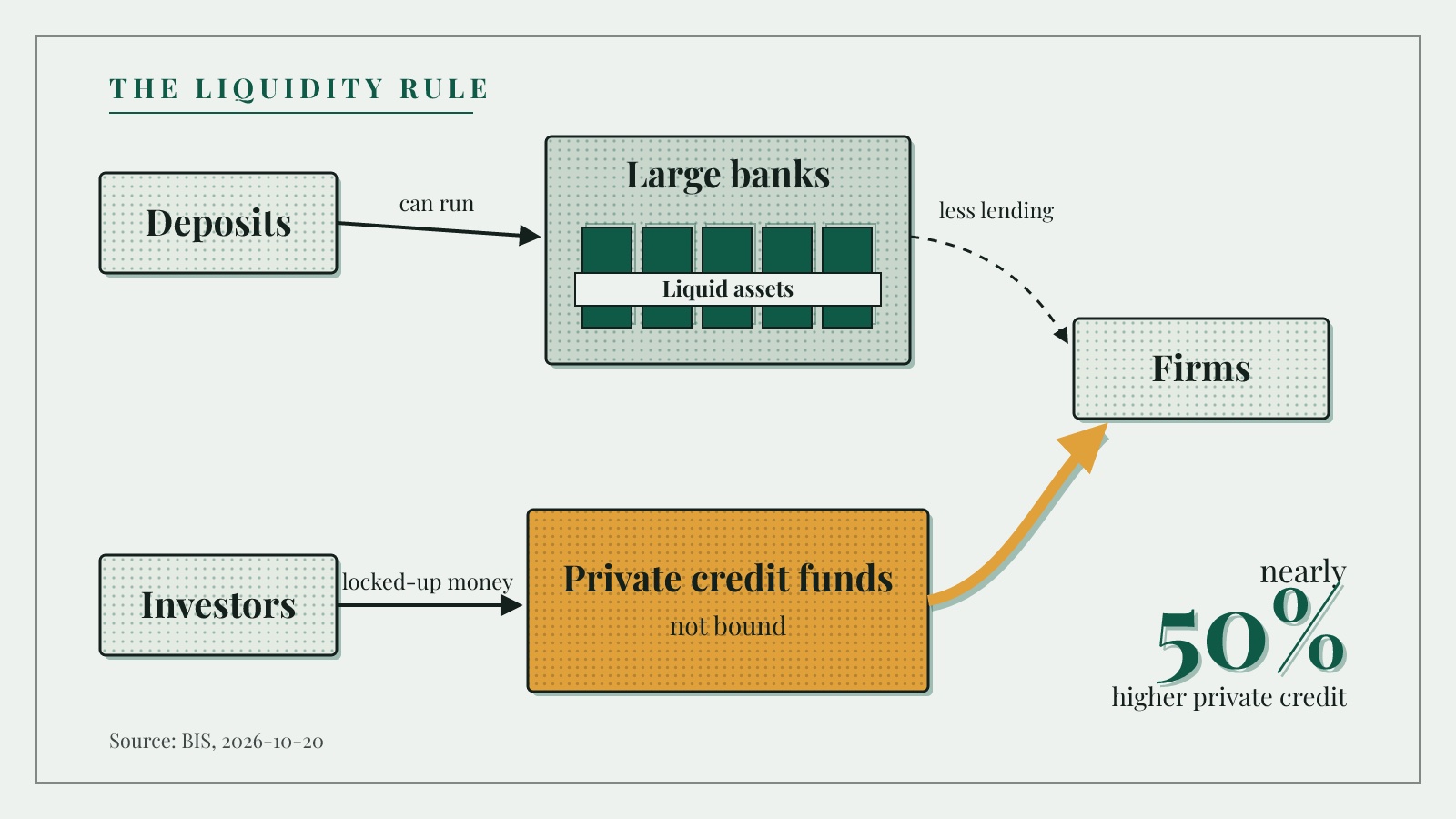
A new working paper from the BIS, published on 2026-10-20, asks how far bank liquidity rules helped private credit grow. Its answer is: quite a lot, at least in the US. This article explains the rule involved, why it can push lending away from banks, and what the paper leaves open.
What the BIS paper found
The study comes from the Monetary and Economic Department of the BIS, the Bank for International Settlements, which serves central banks. It looks at the Liquidity Coverage Ratio, or LCR, the US version of global liquidity standards that the Basel Committee on Banking Supervision set after the 2008–09 crisis. In the US, the LCR applies to large banks.
The authors compare US counties. Where banks bound by the LCR had a bigger local presence, or started with larger liquidity shortfalls, private credit grew noticeably more once the rule took effect. According to the BIS paper, a county with a one standard deviation larger prior footprint of LCR banks saw nearly 50% higher private credit volumes afterwards. The authors say this effect is about as large as that of the higher capital demands from the 2012 CCAR stress tests.
How this works: a liquidity rule and a loan
A bank funds itself mostly with deposits and other short-term money that can leave quickly. It lends much of that money out as loans that cannot be sold fast. That mismatch is the risk the Basel standards target: financing hard-to-sell assets with funding that can run.
The LCR answers this with a buffer. It is easiest to see as a chain of steps:
- The bank estimates how much cash could flow out in a period of stress.
- It must hold enough high-quality liquid assets, such as cash and safe government bonds, to cover those outflows.
- Every illiquid loan to a mid-sized company now has a cost: the bank must keep matching liquid assets that earn little.
- A lender that is not a bank, and is not funded by runnable deposits, does not carry that cost.
That last step is where private credit comes in. In the paper, private credit means loans made directly by non-banks and held by private credit funds and BDCs, or business development companies. These funds raise money from investors who usually cannot pull it out on demand. So the liquidity rule written for banks does not bind them, and a loan that has become expensive for a bank to hold can be cheaper for a fund to make.
The county comparison is how the authors try to separate this effect from everything else happening at the same time. If the rule had no effect, places dominated by LCR banks should look like places that are not. They did not. The tie was also tighter in industries that rely more on borrowing, which the authors read as a loan supply effect: firms did not suddenly want more credit, banks offered less and funds stepped in.
What changes, and for whom
For borrowers, the lender on the other side of the table changes. A company that once borrowed from a large bank may now borrow from a fund. The BIS paper notes that private credit has grown fast over recent decades and is now a major funding source for many kinds of firms.
For supervisors, the picture of where risk sits changes. A loan held by a deposit-funded bank can trigger a run if depositors lose confidence. The same loan held by a fund with locked-up investor money carries less of that liquidity risk. But the fund sits further from the bank supervisors who designed the rule in the first place.
The paper also places itself alongside other explanations. Low interest rates, investors reaching for yield and bank capital rules are all commonly cited drivers of private credit. Earlier evidence, it says, already showed liquidity rules crowding out some lending at affected banks and moving activity toward smaller, lightly regulated banks. This study adds non-bank funds to that list.
Open questions the paper leaves unanswered
The biggest one is stated by the authors themselves. Moving loans from deposit-funded banks to funds may cut liquidity risk a lot, but, in their words, "total systemic risk effects are complex, and assessing them is beyond the scope of the paper". Systemic risk is the danger that trouble at one firm spreads through the whole system.
Several practical questions follow. How much do these funds borrow from banks themselves, which could bring risk back onto bank balance sheets? What happens to borrowers if fund investors become less willing to commit money? And do findings from US counties carry over to other countries that apply the Basel standards in their own way? The paper, as summarised here, does not answer these.
Sources
- BIS, 20 Oct 2026
How this post was made: an AI model drafted it from the sources listed above, and software checks ran before it went live without a human edit. Every figure has to match a listed source and no sentence is copied. It explains how the mechanism works; it is not investment advice.